

Funniest Vape Memes Community Humor & Inside Jokes
Brutal burnt coils and dead batteries become pure gold through these hilarious vape memes. Laughing at these inside jokes solves your vaping struggles now.
Read now

Shipping vape products involves strict federal laws, carrier bans, and state-level rules. This guide breaks down the current delivery policies, identity checks, and exact steps required to safely ship and receive orders in 2026.
Major shipping companies refuse to handle consumer vape orders. Finding a reliable delivery service requires piecing together smaller logistics networks. This drastically changes the speed and cost of online shopping.
National carriers have effectively closed their networks to consumer vape shipments. Stores cannot treat vape juice like normal e‑commerce parcels anymore.
For the USPS (United States Postal Service):
For large private couriers:
What this means for small vape shops:
In short:
Standard USPS and big‑carrier labels are not safe options for vape shipping. Stores must rely on regional or specialized carriers instead.
|
Carrier Type |
Direct-to-Consumer Allowed? |
Business-to-Business Allowed? |
Notes |
|
National Postal Service |
No |
Limited exceptions |
Strict federal restrictions apply to consumer orders |
|
Primary Private Couriers |
No |
Restricted |
Requires special contracts and rigorous legal approval |
|
Secondary Private Couriers |
No |
Highly restricted |
Broad bans remain in place across the network |
|
Regional Delivery Networks |
Limited / Varies by provider and local regulations |
Yes |
Coverage depends entirely on the specific state and ZIP code |
Because national carriers stepped away, most vape orders now travel through regional and local delivery networks. This change allows vape shipments to move again, but it creates new limits that both stores and buyers feel.
For customers, the result is clear: fewer shipping options, longer waits, and more cases where the website simply refuses the address. For retailers, it adds another layer of complexity on top of age checks and state‑specific rules.
Selling age-restricted items online requires proof of identity at two distinct stages. A simple website pop-up asking the buyer's age is completely illegal. Strict identity checks happen during checkout and upon delivery.
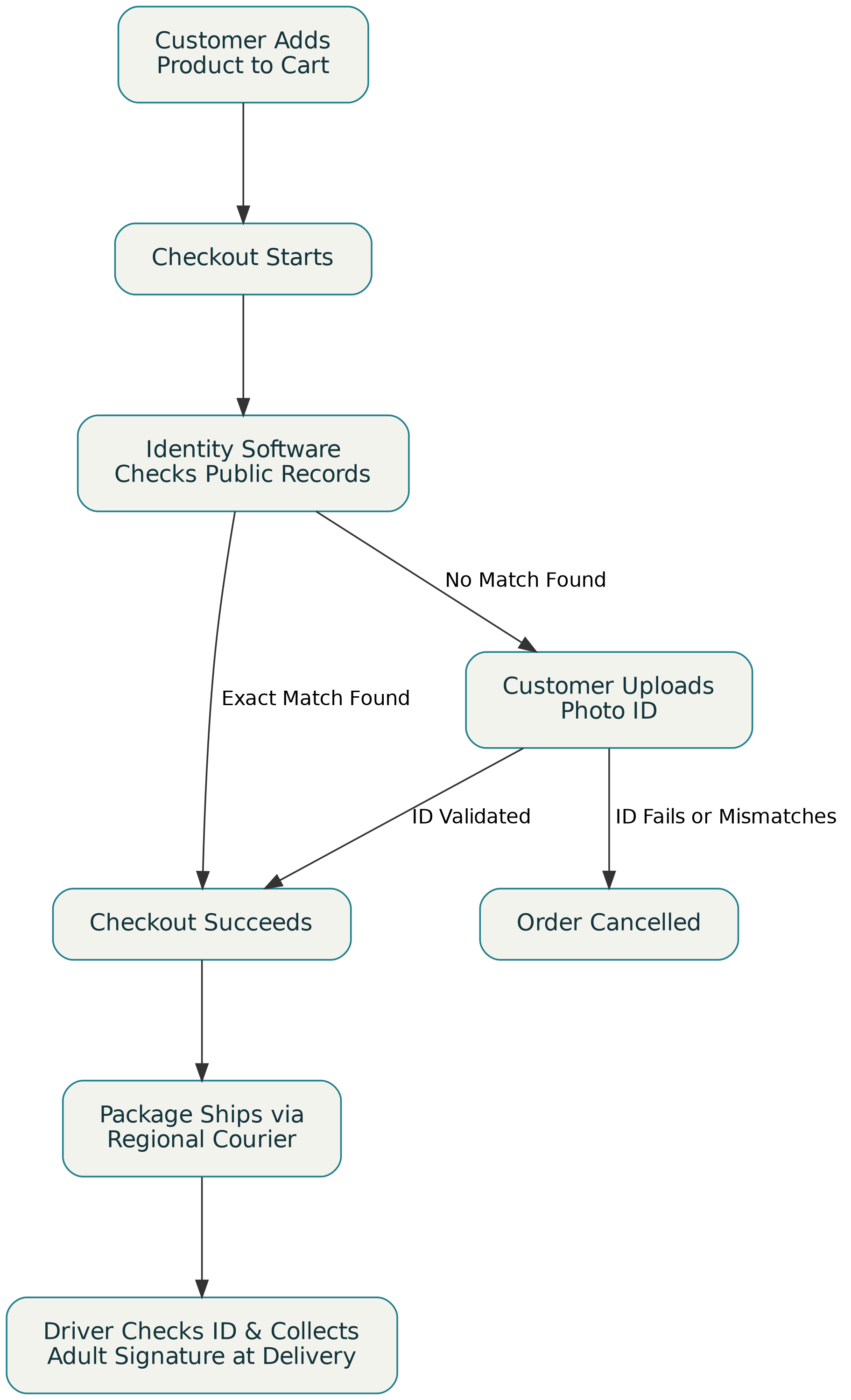
Age checks are the second big reason vape shipping feels very different from regular online shopping. Stores must prove the buyer is 21 or older at checkout and again at the door, or they risk serious penalties.
The process starts online, before payment is completed. A simple "Are you 21?" pop‑up is not enough. Stores use age‑verification tools that check customer data against public records.
First, the buyer fills in their name, address, and date of birth. The system compares this information with databases. If everything matches, the order can move forward without extra steps.
If there is no clear match, the buyer is asked to upload a photo of a government ID. The name and date of birth on the ID must match the details entered at checkout. Blurry photos, nicknames instead of legal names, or outdated addresses all increase the chance of failure.
When the system still cannot confirm age after these steps, the store cancels the order. That feels harsh from the customer's side, but it protects the business from large fines and legal action. Many abandoned carts in this niche are caused by these failed checks, not by price alone.
The second checkpoint happens at the door. Delivery drivers are not allowed to leave vape packages unattended. They must hand the parcel to an adult who can prove they are at least 21.
The driver asks for a government‑issued ID and checks both the photo and the date of birth. If no suitable adult is available, the driver does not leave the package. Instead, they attempt delivery again or return the parcel to the depot.
This extra step adds cost. Adult signature services usually increase the shipping price by several dollars. It also adds friction. People who work outside the home during the day often miss drivers, which leads to multiple attempts and, in some cases, a return to sender.
For the store, every failed delivery is expensive. They have paid the shipping charge and handling cost, and may need to refund the customer. This is why many retailers clearly warn customers about the need for an adult to be present and encourage shipping to addresses where someone can reliably sign.
Even with both checks in place, some orders still fail. The common reasons are simple:
From a customer's point of view, it can feel like the store is being difficult. From the store's perspective, these blocks are the only way to avoid fines, license problems, or seized inventory.
Local laws create another layer of complexity for shipping vape products. Sellers must track changing regulations in all fifty states to avoid shipping illegal orders. Rules vary drastically across state lines.
Many states now use strict product registry systems. In places like Alabama, Louisiana, and Oklahoma, retailers can only sell items that possess federal authorization or a pending application. You can view the approved product lists directly through the Electronic Nicotine Delivery System (ENDS) Manufacturers Directory - Alabama Department of Revenue, the Louisiana V.A.P.E. Directory, and the Oklahoma ABLE Commission Directory. Shipping unapproved items into these states violates local law. California strictly enforces flavor bans at the retail level and heavily restricts online shipments through rigorous age-verification laws and local city ordinances.
The strict rules make it nearly impossible to ship even unflavored vape juice legally into certain areas. Sellers must block entire states from their shipping zones to stay compliant. Staying updated on these changing state laws is a daily task for business owners. A product perfectly legal in Texas might be completely banned in Massachusetts. State attorneys general actively monitor online stores to catch companies shipping banned items into their borders. They run sting operations by placing controlled orders. If a retailer ships an unauthorized flavor into a restricted state, they face immediate lawsuits.
Compliance requires specific labeling on both the outside and inside of the shipping box. Externally, packages must display clear text stating the contents include tobacco or restricted products. Internally, retailers must include specific paperwork. State tax boards require an itemized tobacco invoice or a detailed packing slip to support monthly tax reporting. Missing labels or incorrect paperwork leads to delayed shipments or seized inventory during inspections.
Proper documentation proves the seller collected the right taxes and followed federal rules. The external labels must follow strict sizing and font requirements. A tiny warning sticker hidden on the bottom of the box is not acceptable. The internal invoice must show the exact tax amounts collected. State inspectors use these invoices to verify the company paid all required local taxes, which perfectly aligns with the federal PACT Act reporting and tax compliance rules.
Retailers must follow a strict process for every single order:
The PACT Act sits behind many of the shipping rules you deal with today. It controls how vape products move across state lines and what online sellers must report.
The law started as a way to fight traditional cigarette trafficking. Later updates pulled Electronic Nicotine Delivery Systems into that framework. In practice, that reach is very wide.
It does not stop at bottles of nicotine e‑liquid. It also covers:
Even zero‑nicotine liquid and many hemp or CBD products get pulled in because of the hardware. Regulators focus on the device and delivery system, not just what is inside the tank or pod. If the item functions like a vape, it is usually treated like one.
For shipping, this means you cannot separate hardware and liquid and expect to escape regulation. Coils, empty pods, and replacement glass are treated as parts of a regulated system. From the law's point of view, the whole package still counts as a restricted shipment.
For online sellers, the PACT Act is not just theory. It turns into specific tasks and ongoing obligations.
Most compliant sellers who ship across state lines must:
If they miss these steps, they face real penalties. That can include large fines, loss of licenses, or even criminal charges in serious cases. The law expects a clear paper trail for every shipment and every taxable sale.
This workload affects how a vape website actually operates. Checkout flows need to handle tax lookups and age checks. Back‑office systems need to track which products are legal in which states. Staff or outside accountants have to prepare monthly reports instead of just yearly tax returns.
For a small store, this is heavy. Some try to limit risk by:
The end result is higher operating costs, which is a big reason shipping vape juice feels more expensive than shipping many other consumer products.
Hemp and CBD vapes are often marketed as a way around nicotine rules. In shipping, that assumption is usually wrong.
The law still looks closely at:
If it looks and works like a vape pen or disposable, regulators tend to treat it like any other vape device. That keeps it under the same age‑verification, shipping, and reporting rules.
This is why many CBD vape sellers see the same problems as nicotine brands: blocked shipments, account reviews, and questions from carriers. Treating CBD hardware as if it were just a neutral "wellness device" can get packages seized and accounts shut down.
To stay safe, most serious hemp and CBD players follow the same shipping standards as nicotine sellers. They use age verification, adult signatures, proper labels, and tax reporting, even if the liquid does not contain nicotine.
Yes, but only through vape‑friendly regional carriers and only if your state and ZIP code allow it. An adult aged 21 or older must be present to show ID and sign for the package. If you are rarely home, shipping to a work address or another place where someone can reliably sign often makes delivery smoother.
Yes. The law classifies the physical hardware, such as batteries and empty cartridges, as regulated devices. The rules apply no matter what type of liquid goes inside the device. Sellers must verify age and collect signatures for these items just like traditional tobacco products.
Most stores run a basic check at checkout and a deeper review before shipping. Your order can pass payment but later be blocked if your address is in a restricted state or ZIP code, if the product is not legal where you live, or if the store spots a problem in the age‑verification details. In those cases, the shop cancels and refunds to avoid legal and compliance issues.
Vape shipping costs more because several extra layers sit on top of the base delivery fee. Stores pay for adult signature services, higher regional carrier rates, age‑verification tools, and added tax and reporting work, and in some areas, they must also collect excise taxes. All of that gets built into the total you see at checkout, so even a low‑priced bottle can carry a noticeably higher shipping cost.

